OEM Mercedes-Benz Parts UK vs. Aftermarket: Which Is Best for You?
Table of Contents
Driving a Mercedes-Benz is a statement of class, performance, and pride—but when it’s time for repairs or replacements, one critical decision can make or break your driving experience: should you choose OEM Mercedes-Benz parts UK or go for cheaper aftermarket alternatives?
Across major cities like London, Birmingham, and Manchester, thousands of Mercedes owners are faced with this dilemma. It’s not just about price—it’s about quality, compatibility, resale value, and long-term peace of mind. Whether you own a C-Class, E-Class, or an AMG model, the parts you choose directly affect how your vehicle runs, feels, and lasts.
In this blog, we’ll guide you through the differences between OEM and aftermarket Mercedes parts, bust myths, compare real-world examples, and help you make a decision that protects your car—and your wallet.
👉 Looking to dive deeper into OEM parts in general? Don’t miss our detailed guide on genuine OEM car parts in the UK.
What Are OEM Mercedes-Benz Parts?
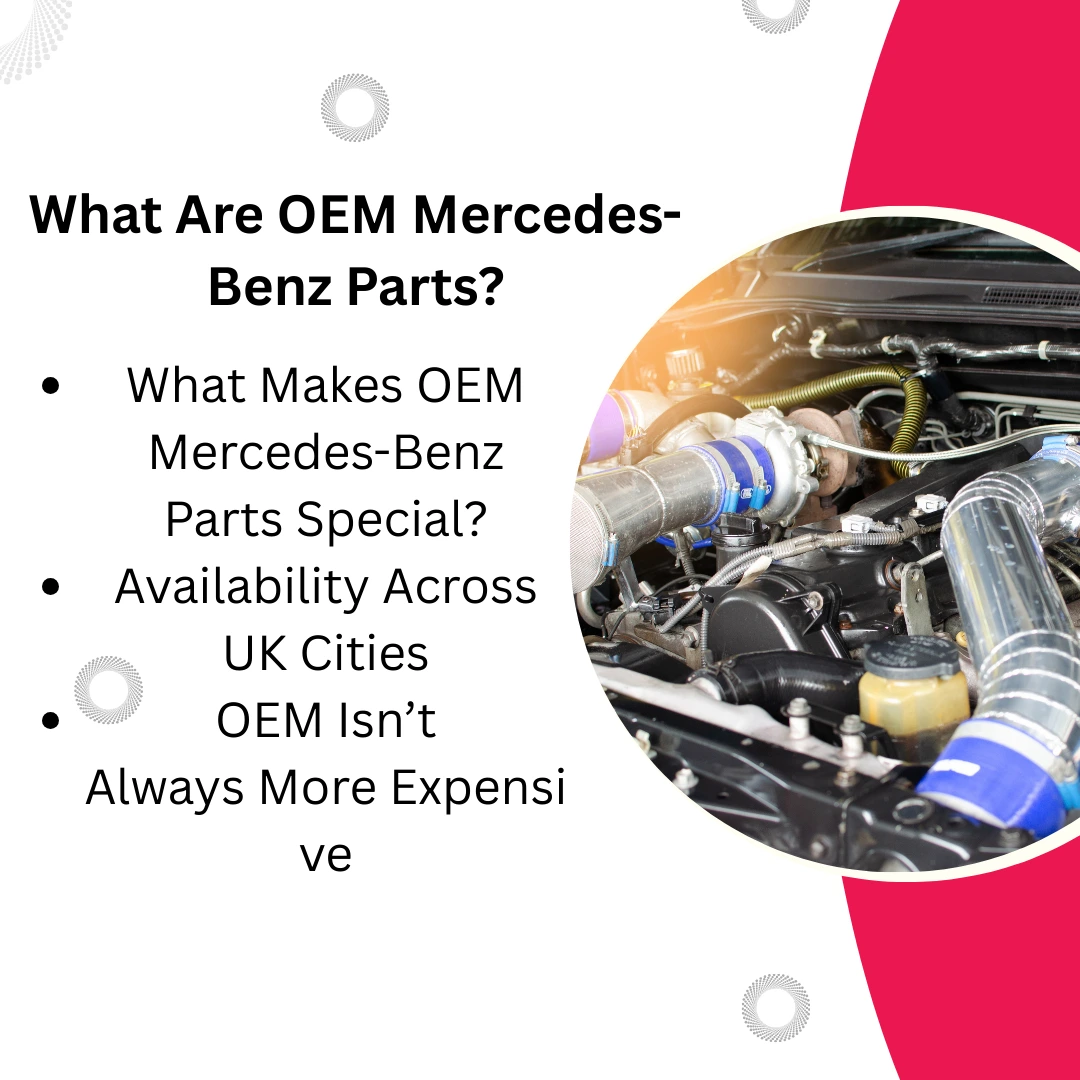
When Mercedes-Benz builds a car, every component—from the engine to the smallest bolt—is selected and tested for precision, safety, and longevity. OEM stands for Original Equipment Manufacturer, and in this context, it refers to parts either manufactured by Mercedes-Benz itself or by official suppliers chosen and approved by the brand.
These aren’t “just parts.” They’re the exact components your Mercedes came with when it rolled off the production line.
🛠️ What Makes OEM Mercedes-Benz Parts Special?
- Exact Fit: OEM parts are designed with millimeter-level precision for Mercedes vehicles. They’re a 100% match in size, function, and performance.
- Factory-Grade Quality: Every OEM component goes through Mercedes’ strict quality control tests—ensuring reliability under UK road conditions.
- Warranty Protection: OEM parts often come with warranties, and using them helps you avoid accidentally voiding your existing vehicle warranty.
- Engineered for Performance: From brake pads to electrical modules, every OEM part is designed to work in harmony with your car’s onboard systems.
Using OEM Mercedes-Benz parts in the UK also offers a major psychological benefit—peace of mind. When you buy from a trusted brand like MDL Auto Parts, you’re not guessing whether a part will fit. You’re hoping it won’t cause an error light. You’re getting what your vehicle was designed to work with.
🏙️ Availability Across UK Cities
Whether you’re searching for OEM Mercedes-Benz parts in London, OEM parts for Mercedes in Edinburgh, or genuine Mercedes components in Southampton, authorized suppliers now offer UK-wide delivery and support. That means even if you live outside a major metro, you’re no longer limited to local garages or generic auto stores.
🔒 OEM Isn’t Always More Expensive
It’s a myth that OEM always costs double. While prices may be higher upfront than some aftermarket alternatives, OEM parts often outlast cheap replacements by years, reducing your total cost of ownership.
“I once replaced my E-Class’s control arm with a cheaper aftermarket brand—it failed within 8 months. Switched to OEM, and I haven’t touched it in 3 years.”
— Amir R., Nottingham
What Are Aftermarket Mercedes Parts?
When you walk into a car parts store or browse online marketplaces, you’ll often come across parts labeled as “Mercedes-compatible,” “OEM-style,” or “aftermarket fit.” These are all terms used to describe aftermarket parts—components made by third-party manufacturers without direct authorization or licensing from Mercedes-Benz.
While these parts may fit your car, they’re not produced by the same factories that supply parts to Mercedes. And that can make a world of difference.
✅ Internal link: Mercedes-Benz Service Page
🏭 Who Makes Aftermarket Parts?
Aftermarket parts come from a wide spectrum of manufacturers. Some are reputable, specializing in specific components like brake systems or lighting. Others are mass producers offering low-cost parts for dozens of car brands at once—often sacrificing precision for scalability.
There are generally three tiers of aftermarket manufacturers:
- High-quality specialist brands (e.g., Bosch, Brembo, Mann)
- Generic OEM-style producers (non-Mercedes-certified but reliable)
- Budget, no-name brands (widely available but inconsistent quality)
When searching for Mercedes parts comparisons in Sheffield or even online forums, you’ll often see users debating these tiers—some satisfied, others burned by failures or compatibility issues.
⚖️ Pros of Aftermarket Mercedes Parts:
✅ Lower Initial Cost
Aftermarket parts are often 20–50% cheaper than OEM equivalents. For older cars or non-critical components, this makes them attractive.
✅ More Options
You can sometimes find performance-enhancing parts that OEMs don’t offer (e.g., upgraded exhausts or tunable ECUs).
✅ Faster Availability
In emergencies, aftermarket parts might be more readily available locally, especially in smaller towns.
🚩 Risks of Aftermarket Parts:
❌ Compatibility Issues
Even if a part “technically fits,” it might require extra adjustments—or cause new issues down the line. This is especially common with electronics, sensors, and suspension parts.
❌ Warranty Problems
Installing a poorly made aftermarket part could void your Mercedes warranty if the part contributes to damage.
❌ Inconsistent Quality
Aftermarket standards vary wildly. A part from a trusted brand may last years; a knockoff version might fail in months.
❌ Resale Impact
If you plan to sell your car, service records showing aftermarket parts could decrease buyer confidence.
🔍 Real Owner Insight:
“I installed aftermarket headlights on my C-Class to save £100. Two months later, the right one shorted and triggered a dashboard fault. Never again.”
— Ellie M., Sheffield
For UK drivers comparing options—especially in cities like Glasgow, Sheffield, or Newcastle upon Tyne—aftermarket isn’t always a bad choice, but it’s a calculated risk. You might save now but pay later in performance, reliability, or even safety.
OEM vs. Aftermarket—Side-by-Side Comparison
Let’s be honest—both OEM and aftermarket parts have a place in the auto industry. But when it comes to a high-precision vehicle like a Mercedes-Benz, the stakes are higher. Choosing the wrong part can affect everything from ride comfort to engine efficiency and even your car’s resale value.
To help you make a clear, confident choice, here’s a side-by-side comparison of the most important factors Mercedes owners in the UK should consider.
📊 Mercedes Parts Comparison Table
| Feature | OEM Mercedes-Benz Parts | Aftermarket Mercedes Parts |
| Manufacturer | Mercedes-Benz or official supplier | Independent third-party companies |
| Fit & Compatibility | Perfect match to original parts | May vary; sometimes requires modifications |
| Quality Assurance | Factory-tested, meets Mercedes standards | Varies widely; depends on brand |
| Warranty Impact | Fully preserves manufacturer warranty | Risk of voiding warranty if failure occurs |
| Durability | High longevity, designed for Mercedes engines | Some last long; others fail early |
| Cost | More expensive upfront | Typically 20–50% cheaper |
| Availability | Widely available online or via certified dealers | Extremely wide selection, online and local |
| Resale Value Impact | Preserves resale confidence | May decrease resale value |
| Support & Returns | Backed by authorized channels | Depends on seller or platform |
💬 What Does This Mean in Real Terms?
Let’s break it down with a simple example.
Say you’re based in Bristol, and your C-Class needs a new alternator. An OEM alternator might cost you £290, but you get the peace of mind that it will fit, work, and last—possibly for the life of the car.
Meanwhile, a budget aftermarket version might cost £140. Sounds great—until 6 months later, it fails and causes a power system issue. Now, you’re not only paying for another alternator but also diagnostics and potential damage repair. That £140 “deal” just became a £500 headache.
This kind of situation is common in cities like Liverpool, Leicester, and Nottingham, where local garages may suggest aftermarket parts for faster fixes. Always ask, what’s the real cost in the long run?
📌 Quick Rule of Thumb:
| Use Case | Best Choice |
| Critical mechanical or electrical parts | ✅ OEM |
| Body panels and safety equipment | ✅ OEM |
| Non-critical (e.g., floor mats, bulbs) | 🔄 Aftermarket OK |
| Performance upgrades | 🔄 Depends on brand |
🔑 SEO Boost: Local Intent Integration
Across the UK, buyer habits vary:
- In Manchester, car owners often prefer OEM due to harsh winters and road salt.
- In Leicester, price sensitivity leads many to try aftermarket first.
- In Southampton, long-distance drivers value OEM reliability for highway trips.
- In Newcastle upon Tyne, owners of older Mercedes models lean on OEM for better resale.
So the question isn’t just about what you’re buying, but where and why—and how long you plan to keep the car.
Why OEM Parts Matter for Mercedes Owners in the UK
When you invest in a Mercedes-Benz, you’re not just buying a car—you’re embracing a driving experience rooted in engineering perfection. That experience doesn’t stop after the purchase. It extends into how you maintain and repair your vehicle—and this is where OEM parts become non-negotiable for many UK drivers.
🧠 It’s Not Just About Fit—It’s About Trust
Mercedes vehicles rely on complex onboard systems—from adaptive suspension to AI-powered braking. Even a single non-OEM sensor or fuse can interfere with your car’s communication systems.
In a country like the UK, where conditions vary from wet urban traffic in Leeds to icy countryside roads in Edinburgh, part performance isn’t just technical—it’s a matter of safety.
Consider this:
- An OEM brake pad will wear evenly, respond predictably, and keep anti-lock systems calibrated.
- A cheap aftermarket brake pad might fit the caliper—but may produce uneven wear or sudden fade under heat, throwing off your braking system entirely.
The difference can be the length of a car—or a crash.
🔧 Real Stories from Real UK Roads
“I was on the M6 near Birmingham when my dashboard lit up. Turns out the aftermarket fuel pump I had installed saved me £90 — but cost me my engine. I’ve only used OEM since.”
— Kyle R., Birmingham
“My C-Class needed a mirror replacement. The local shop offered an aftermarket one for half the price, but it didn’t auto-dim properly at night. That’s when I realized: not all savings are smart.”
— Nafisa P., Leicester
📍 Why This Matters More in the UK
Let’s face it—UK roads aren’t easy on luxury vehicles. Here’s what OEM parts help protect you from:
- Hard water corrosion in coastal towns like Southampton
- Pothole-related suspension damage in busy cities like Liverpool
- Cold-weather engine stress in Newcastle upon Tyne and Glasgow
Unlike mass-produced aftermarket parts, OEM components are tested under the exact same environmental conditions your vehicle faces—often in UK-specific testing labs run by Mercedes and its partners.
🛠️ OEM = Retained Warranty + Higher Resale
Using OEM Mercedes-Benz parts UK ensures your vehicle retains:
- ✅ Manufacturer-backed warranty (some aftermarket installs void it)
- ✅ Service record trust (especially important for private resales)
- ✅ Diagnostic compatibility with Mercedes dealerships
Imagine selling your car to a discerning buyer in Nottingham or Coventry. One look at your service history—packed with OEM parts—and they’ll know you’ve cared for the car properly. That’s resale leverage.
📈 OEM Today = Fewer Repairs Tomorrow
One of the most underrated benefits of OEM is long-term reliability. Even though initial prices are higher, OEM parts are designed to last longer—which means fewer visits to the garage, less labor cost, and fewer surprise failures.
It’s not just cost—it’s confidence.
“Since switching to OEM parts, I haven’t seen the inside of a workshop in two years—apart from oil changes.”
— Linda A., Southampton
When Aftermarket Parts Make Sense
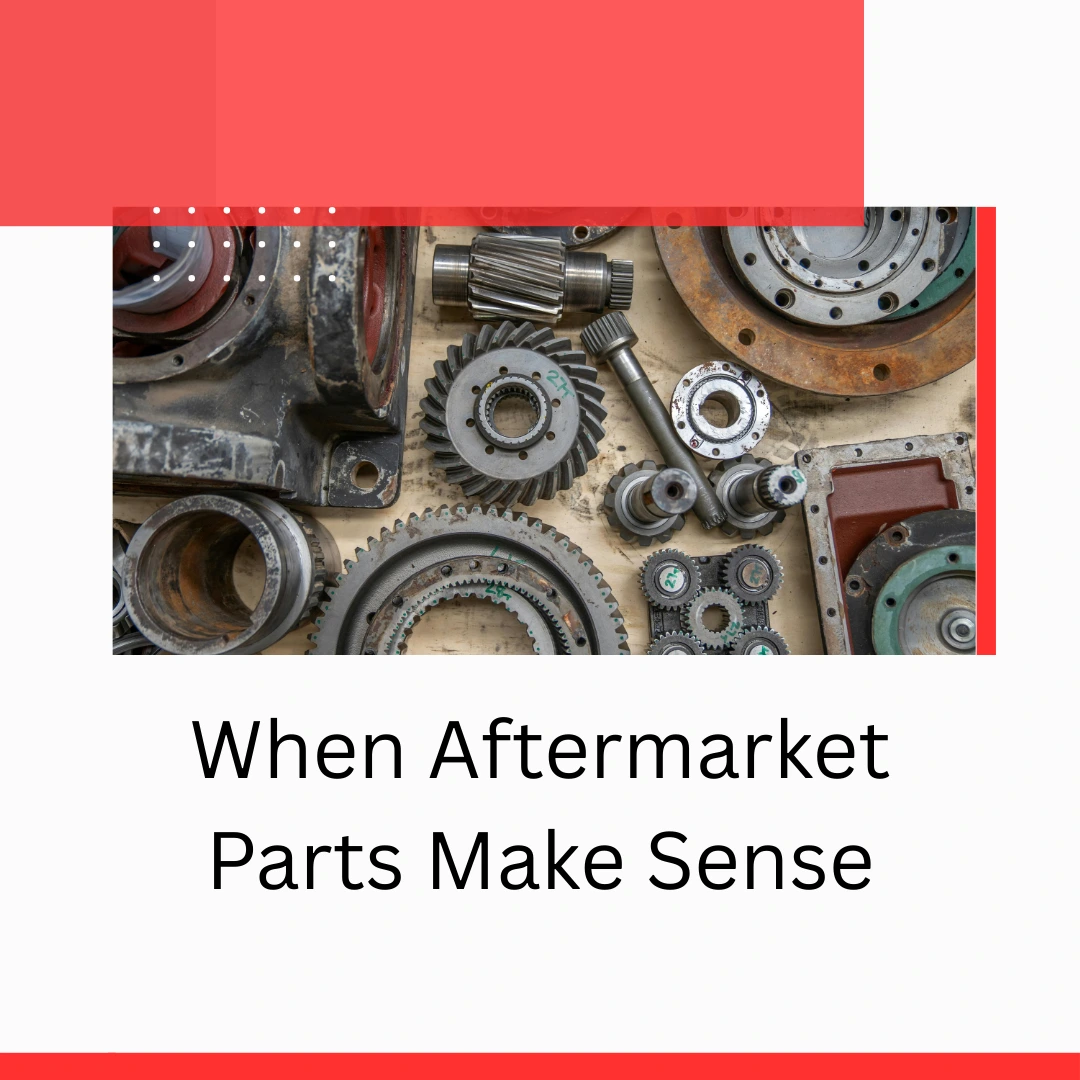
While OEM Mercedes-Benz parts UK are generally the gold standard, not every repair demands perfection—and not every budget can stretch for it. In some cases, aftermarket parts are not only acceptable but logical.
Let’s look at where and when aftermarket options can be smart—as long as you make informed choices.
🔄 Scenario 1: Non-Critical Components
For parts that don’t affect the core safety or performance of your Mercedes-Benz, aftermarket options can be perfectly fine.
✅ Examples include:
- Floor mats
- Cabin air filters
- Interior trim pieces
- Windshield wipers
- License plate lights
You don’t need to spend £100 on a Mercedes-Benz-branded boot liner if a high-quality aftermarket one does the job for £30 — especially if you’re just trying to protect your upholstery.
In cities like Coventry or Leeds, where daily commutes add wear and tear quickly, these low-risk upgrades from trusted brands can be a smart budget move.
⚙️ Scenario 2: Out-of-Warranty Vehicles
If your Mercedes is 10+ years old and out of manufacturer warranty, the financial case for OEM parts becomes weaker.
Why?
Because at that point:
- Your resale value is already lower
- A buyer won’t expect brand-new OEM across the board
- Spending £400 on OEM for a £2,500 car isn’t always justifiable
In this case, using aftermarket Mercedes parts in Sheffield or Nottingham could help keep the vehicle roadworthy without draining your wallet—provided you stick with reputable brands like Bosch, Bilstein, or Hella.
🛑 But Beware: Know What’s NOT Safe to Replace with Aftermarket
Even in older vehicles, you should avoid aftermarket parts in the following areas:
- 🚫 ABS sensors
- 🚫 Engine control modules (ECMs)
- 🚫 Transmission solenoids
- 🚫 Suspension bushings (unless high-grade aftermarket)
- 🚫 Airbags or safety systems
A cheaper version might look the same—but performance under stress could fail, leading to far costlier repairs or even safety issues.
💬 What Mercedes Owners Say:
“I drive a 2009 E-Class. I use aftermarket filters and hoses to save cash, but for anything electronic or engine-related, it’s OEM only.”
— Darren S., Coventry
“Had an issue with my glovebox latch — aftermarket fixed it for £12. Dealer wanted £95 for the same thing. No regrets there.”
— Yasmin T., Liverpool
✅ When Aftermarket Can Be Smart (if…):
| Condition | Go Ahead With Aftermarket |
| Part is non-critical | ✅ Yes |
| Car is out of warranty | ✅ Yes |
| Manufacturer no longer makes OEM | ✅ Yes |
| Trusted third-party brand | ✅ Yes |
| Seller has no reviews/vague specs. | ❌ No |
| Part affects engine/safety | ❌ No |
Summary Thought:
Aftermarket isn’t the enemy—it’s a tool. But like any tool, it’s only effective if you know when, where, and how to use it.
🔚 So, OEM or Aftermarket—What’s Right for You?
Choosing between OEM and aftermarket Mercedes-Benz parts in the UK isn’t always black and white. It depends on what part you’re replacing, your budget, the age of your vehicle, and how long you plan to keep it.
But one thing is clear: if you value precision, safety, and long-term reliability—and want your Mercedes to perform exactly the way it was engineered to—OEM parts are still the safest bet.
That said, aftermarket options can serve you well for non-essential components or older vehicles, as long as you choose wisely and avoid anything that might impact core systems or safety features.
Whether you’re maintaining your vehicle in London, Birmingham, Leicester, or any corner of the UK — your decisions matter. And hopefully, this guide has helped you make them a little more confidently.
Need help finding a part that fits perfectly? The team at MDL Auto Parts is here to assist—not to sell, but to guide.
Our Social Channels & Reviews
We regularly post expert tips and real customer stories on our Facebook page. Curious what others say about us? Check our Google Maps location.
Learn More About Auto Glass Maintenance
Need more than just parts? Explore common causes of windshield damage here on our auto glass blog.
❓ FAQs – OEM Mercedes-Benz Parts UK
Are OEM Mercedes-Benz parts better than aftermarket?
OEM parts are made to exact Mercedes-Benz specifications, ensuring perfect fit, safety, and performance. They’re more reliable, preserve your warranty, and help maintain resale value, especially for UK drivers dealing with varied road and weather conditions.
Are aftermarket parts safe for Mercedes cars?
Some aftermarket parts can be safe if sourced from reputable brands, especially for non-critical components. However, avoid aftermarket for safety systems, electronics, or engine-related parts, as these can affect your vehicle’s reliability or warranty.
Where can I buy OEM Mercedes-Benz parts in the UK?
You can buy OEM Mercedes-Benz parts in the UK from trusted suppliers like MDL Auto Parts, authorized dealerships, or official online retailers offering UK-wide delivery and support.
Do OEM Mercedes parts cost more than aftermarket ones?
Generally, yes. OEM parts usually cost more upfront, but they last longer and perform better, reducing long-term costs. Cheap aftermarket parts may fail sooner, leading to repeat repairs and extra labour charges.
Will aftermarket parts void my Mercedes warranty?
Using aftermarket parts can void your Mercedes warranty if the part fails or causes damage. Always check your warranty terms and choose OEM parts for repairs on newer or under-warranty vehicles.